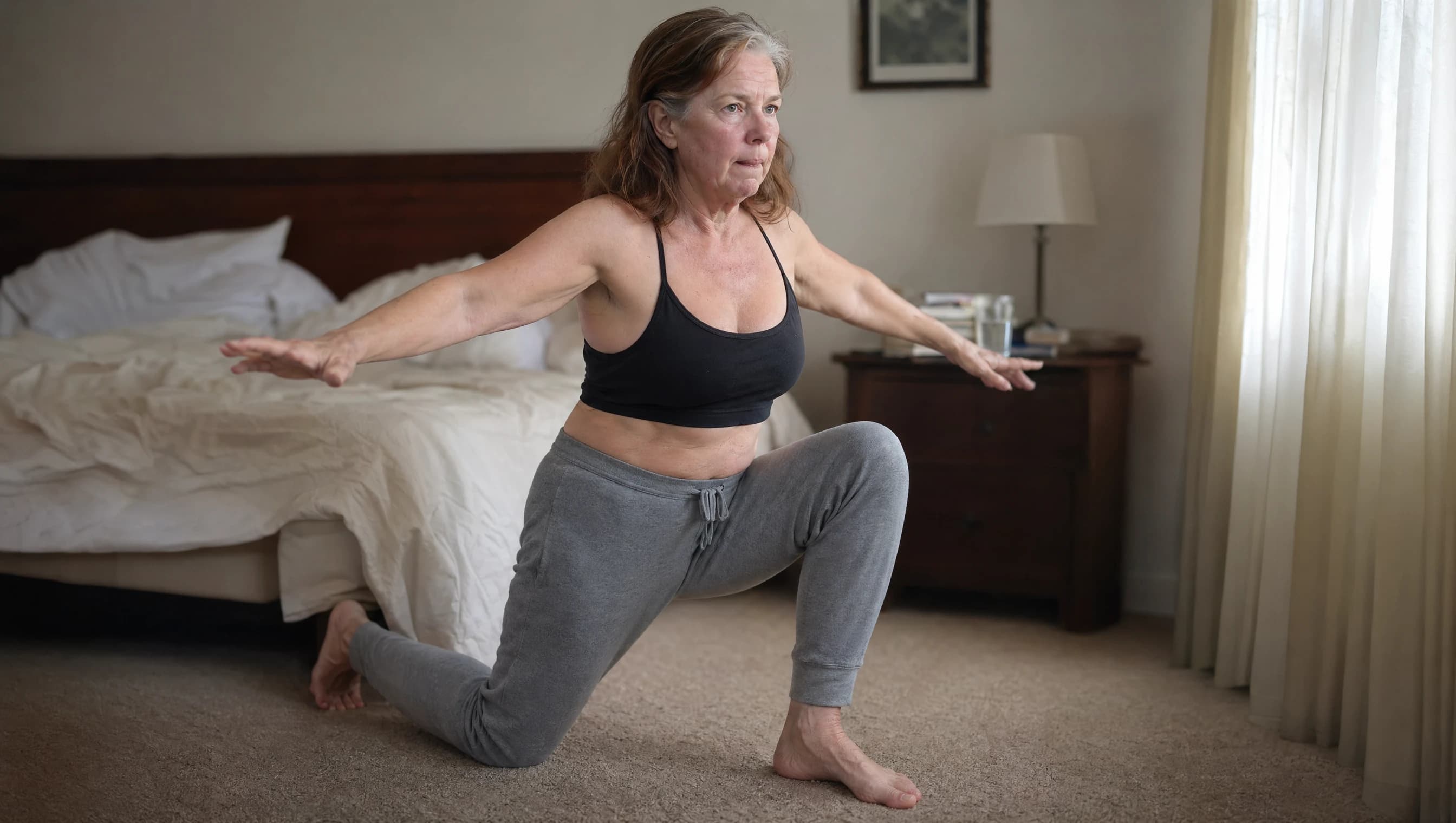
April 28, 2026
Ever feel like you’re rushing through your workouts but not seeing the results you want? Here’s the twist: what if slowing down is the secret you’ve been missing?
Sounds almost too simple, right? But science says otherwise.
Instead of chasing speed, sweat, or complicated routines, more people, especially women training at home are turning to slow, controlled movement training. And honestly? It’s changing the game.
Let’s break down why moving slower might actually get you stronger, leaner, and more balanced without ever stepping foot in a gym.
The Benefits of Slow, Controlled Movement Training at Home
Here’s the deal: When you slow down each movement, your muscles stay engaged longer. This is called time under tension (TUT), and it’s one of the most effective ways to stimulate muscle growth (Harvard Health Publishing, 2023).
In simple terms? The longer your muscles work, the harder they work.
Instead of quickly dropping into a squat and bouncing back up, slowing it down forces your muscles to stay “on” the entire time.
What’s Happening Inside Your Body? - The Cool Science Part
Okay, let’s peek behind the curtain for a second but don’t worry, we’ll keep it simple.
When you perform slow, controlled reps:
- More muscle fibers get activated
Especially the ones that don’t usually join the party - Your brain and muscles sync better
Your nervous system works harder to control each movement - Microscopic muscle damage occurs (the good kind)
These tiny “micro-tears” trigger muscle repair and growth - Momentum disappears
Which means your muscles do 100% of the work
As one expert puts it, slow training “forces muscles to work continuously under tension, optimizing muscle engagement” (ACE Fitness, 2022).
Translation? You get more results from fewer reps.
Fast vs Slow Training: What’s Better?
Let’s clear this up because this is where most people get confused.
- Fast movements - Build power, speed, explosiveness
- Slow movements - Build strength, control, stability, and muscle tone
So no, fast isn’t “bad”but if your goal is to tone up, get stronger, and feel more in control of your body, slow training wins.
Think of it like this:
Fast workouts = cardio vibe
Slow workouts = muscle-building magic
You Don’t Need Weights
Here’s where things get really interesting…
Studies show that even low resistance training, when done slowly and with effort, can produce significant strength gains.
Which means:
- You don’t need heavy weights
- You don’t need machines
- ou don’t even need a gym
You can build strength using just your bodyweight at home.
And let’s be honest that’s a huge win for busy schedules, tight budgets, or just not wanting to deal with crowded gyms.
Why This Is Perfect for Women 45+
After age 30, muscle mass naturally declines by about 0.5% per year, and that loss speeds up after 50 especially for women due to hormonal changes (perimenopause, menopause).
But here’s the good news:
Strength training can slow and even reverse that trend
Slow training makes it safer and more joint-friendly It improves balance, posture, and bone health
Stanford experts highlight that strength training becomes essential during menopause, as declining estrogen affects muscle maintenance but training can directly counteract that.
And here’s the kicker: Slow workouts put less stress on joints while still delivering serious results. So you’re not just working out, you're investing in long-term strength and independence.
How to Do Slow Bodyweight Training at Home
No fancy setup needed. Just a bit of patience (okay, maybe more than a bit).
A simple guideline:
3–1–3 tempo
- 3 seconds to lower
- 1 second hold
- 3 seconds to lift
Warning: it will feel harder than it sounds.
Simple Home Workout (No Equipment Needed)
Here’s a beginner-friendly routine you can try today:
1. Chair Squat (Sit-to-Stand)
Slowly lower yourself to a chair (3–4 seconds), pause, then stand up.
Targets: legs, glutes, core
2. Wall Push-Up
Lean into the wall slowly, then push back.
Targets: chest, shoulders, arms
3. Bird-Dog
Opposite arm and leg extend slowly, hold, then switch.
Targets: core, balance, stability
4. Glute Bridge
Lift hips slowly, squeeze, then lower with control.
Targets: glutes, hamstrings
5. Calf Raises
Up on your toes slowly, then back down.
Targets: calves, ankles, balance
How to structure it:
- 6–10 slow reps
- 1–3 sets
- 2–3 times per week
Common Mistakes (Don’t Skip This Part)
Let’s save you some frustration:
- Rushing through reps (kind of defeats the whole point)
- Using momentum
- Holding your breath
- Choosing too many exercises
Keep it simple. Focus on quality over quantity.
Will This Make You Bulky?
Short answer: no.
Long answer: also no but with science.
Slow, controlled workouts are ideal for building lean, toned muscle, not bulk. In fact, they often produce a more defined look compared to heavy, fast lifting.
So if your goal is to feel strong, look toned, and move better you’re on the right track. A 20-minute focused workout can do more for your body than an hour of rushed, distracted exercise.
Wrapping It All Up (Without Rushing 😉)
Slowing down your workouts might feel unusual at first but it works.
You get:
✔ More muscle engagement
✔ Better balance and coordination
✔ Safer, joint-friendly training
✔ Real results at home
And maybe best of all?
You don’t need to spend hours working out.
Ready to Take the Next Step?
If you want guided, structured workouts that use this exact method
Download the Younger Fitness App and start training smarter.
Sources & Citations
- Harvard Health Publishing – Time Under Tension & Strength Training (2023)
- Schoenfeld, B. (2010) – Mechanisms of Muscle Hypertrophy
- American Council on Exercise (ACE) – Slow Training Insights (2022)
- Mitchell et al. (2012) – Low Load vs High Load Training Study
- NIH – Age-Related Muscle Loss Data (2020)
- Stanford Medicine – Menopause & Strength Training (2022)