March 10, 2026
At some point in midlife, bone health stops feeling like one of those vague future concerns and starts feeling a lot more personal.
Maybe it happens when you hear the word osteopenia for the first time at a routine appointment. Maybe it is when a friend mentions a fracture that came from what seemed like a minor fall. Maybe it is when menopause arrives and suddenly every article, doctor’s visit, and wellness podcast starts talking about estrogen, muscle loss, and bone density like they are all in a conspiracy against your future.
And, well, in a way, they are connected.
After about age 45, and especially during the menopause transition, bone remodeling tends to shift. In simple terms, your body may start breaking down bone faster than it rebuilds it. That does not mean bone loss is inevitable in some dramatic, hopeless way. But it does mean your strategy needs to get smarter. Bone health after 45 is no longer just about drinking milk and hoping for the best. It becomes about building a lifestyle that supports bones from multiple angles at once.
That is the part many women miss.
Yes, food matters. Absolutely. Your bones need raw materials like calcium, magnesium, phosphorus, protein, and vitamin D. But bone health is not only a nutrition story. It is also a movement story, a muscle story, a fall-prevention story, and a consistency story. Strong bones are helped by strong muscles. Better balance lowers fracture risk. Resistance training gives your skeleton a reason to stay sturdy. And daily habits, even the unglamorous ones, quietly shape what happens over the next ten, twenty, or thirty years.
So if you are a woman over 45 navigating menopause and wondering what actually helps, this is the big picture: eat to support your bones, move to challenge them, and train your body to stay steady, strong, and resilient.
Let’s break that down.
Why Bone Health Changes During Menopause
Menopause is not just a hormone event. It is a full-body transition.
As estrogen declines, bone remodeling speeds up. Bone is living tissue, constantly being broken down and rebuilt, but during and after menopause that balance often shifts toward more breakdown than building. Over time, that can increase the risk of osteopenia, osteoporosis, and fractures.
That matters because fractures are not just painful interruptions. They can change the quality of life in a very real way. A hip fracture, vertebral fracture, or serious fall later in life can affect independence, confidence, mobility, and recovery in ways that ripple far beyond the bone itself.
This is why midlife is such an important time to act.
A useful way to think about bone protection after 45 is this:
You need to supply the nutrients bones require.
You need to stimulate bone through movement and muscular loading.
You need to protect yourself from falls by improving strength, balance, and reaction.
And you need to do all of it consistently enough that it becomes a lifestyle, not a short health kick.
Nutrition Matters, But It Is Only One Part of the Equation
Let’s start with food, because yes, it matters, and it deserves a seat at the table. Just not the whole table.
The best eating pattern for bone health after 45 is not about a single miracle food. It is about a repeatable structure that gives your body what it needs most days.
The Bone-Support Basics
Calcium is the headline mineral because it is a major structural part of bone. Women over 50 are often advised to aim for higher calcium intake, and that is for good reason. But more is not always better, and dumping a giant calcium supplement into your day is not the same thing as building a solid routine.
Vitamin D helps your body absorb calcium and supports normal bone mineralization. It is important, but it is not magic. More is not automatically better for everyone, especially if your levels are already fine. This is where targeted support tends to make more sense than random megadosing.
Protein is one of the most underrated bone-health nutrients. Bone is not only mineral. It is also built on a protein matrix, largely collagen. Protein also helps preserve muscle mass, which matters because stronger muscles mean better balance, better function, and fewer falls.
Magnesium, potassium, phosphorus, and vitamin K support bone metabolism and are part of the reason whole foods still matter so much. Leafy greens, beans, dairy or fortified alternatives, nuts, seeds, fish, and fruit all pull their weight here.
The Better Goal: Bone-Smart Eating, Not Bone-Food Obsession
If you are a woman in menopause, a more realistic strategy is to ask:
Am I getting calcium-rich food regularly?
Am I including protein at each meal?
Am I eating plants daily, especially leafy greens, beans, fruit, nuts, and seeds?
Am I making room for foods that support my overall health, not just my bones?
That is a much saner way to do this than trying to memorize the calcium content of twelve foods and treating every meal like a chemistry exam.
A good day might look like yogurt with chia and berries, salmon or beans at lunch, tofu or dairy as a calcium anchor, and a dinner built around protein plus vegetables. Simple. Repeatable. Effective.
But here is the part that deserves more attention than it usually gets.
Fitness Is the Missing Piece in Most Bone Health Conversations
You can eat beautifully and still leave a major part of bone health untapped if your body is not getting the right kind of movement.
Bones respond to load.
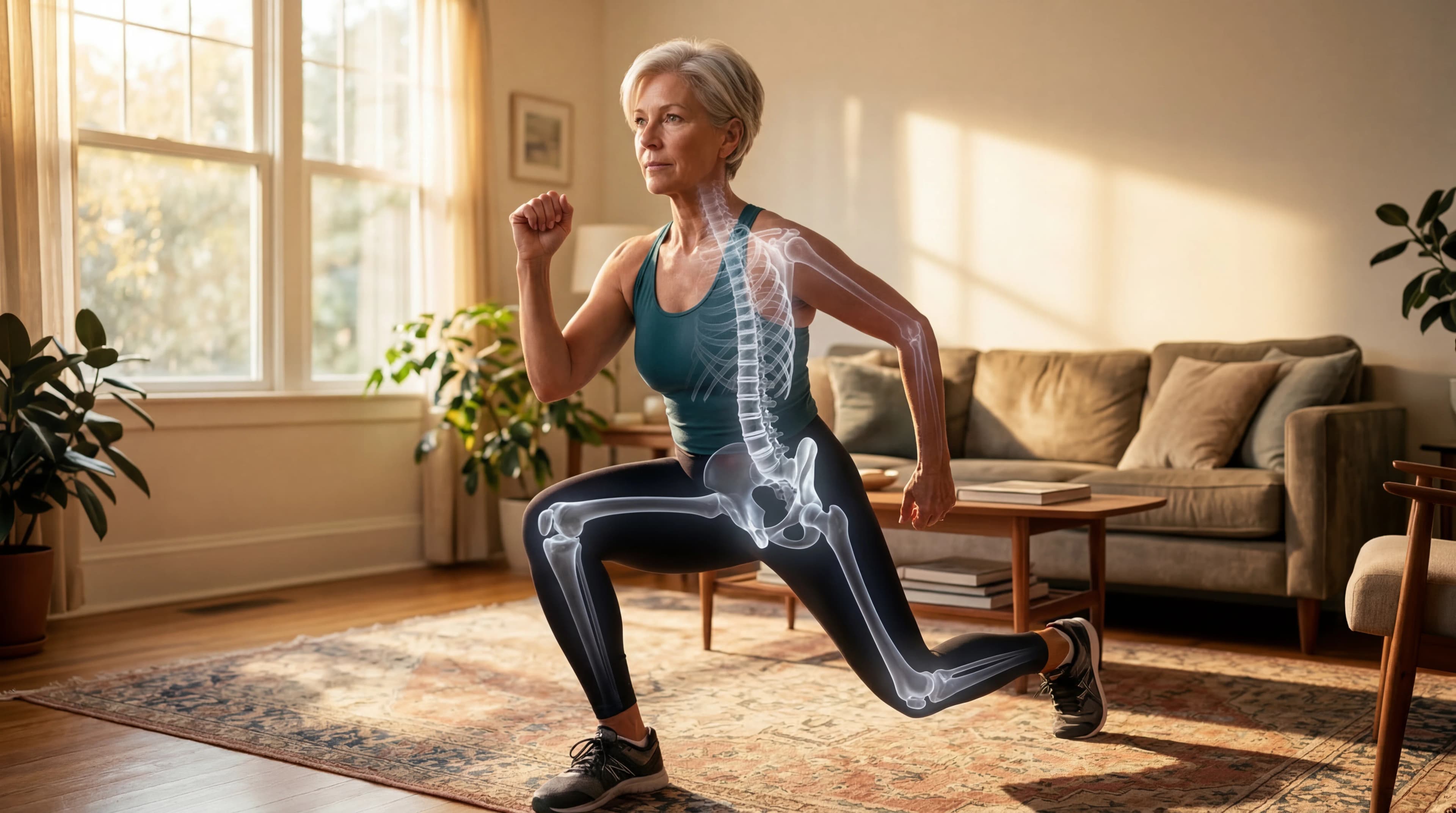
That does not mean you need to start flipping tractor tires or deadlifting like a competitive powerlifter in menopause. It means your skeleton benefits from mechanical stress, especially the kind that comes from resistance training, weight-bearing activity, and impact that is appropriate for your body and health status.
In plain English: your bones need a reason to stay strong.
1. Strength Training Is Not Optional If Bone Health Is the Goal
If you take one big message from this article, let it be this: women over 45 need strength training not just for muscle tone, but for long-term bone protection, balance, metabolism, and independence.
Strength training helps in several ways at once. It loads the bones. It improves muscle mass. It supports joints. It helps posture. It makes daily life easier. And it lowers fall risk by making you stronger and more coordinated.
You do not need a complicated plan to start. A simple routine done two or three times per week can go a long way. Think:
Squats or sit-to-stands
Rows or pulling movements
Push movements like wall push-ups or dumbbell presses
Hip hinges or deadlift patterns
Step-ups
Carrying exercises
Core work
The goal is gradually challenging your body enough that it adapts.
2. Weight-Bearing Movement Helps More Than People Think
Walking is not a complete bone program, but it still matters.
Weight-bearing movement like brisk walking, hiking, dancing, stairs, and low-impact cardio helps keep you active and supports overall function. It is also more sustainable for many women than the all-or-nothing mindset of “real workouts only.”
If you already walk, great. Keep going. If you can add hills, stairs, or a slightly more purposeful pace, even better.
And if you do not walk consistently yet, this is one of the easiest places to begin.
3. Balance Training Is Bone Protection in Disguise
Here is something people often forget: many fractures are not just about fragile bones. They are about falls.
That means balance training is not extra credit. It is part of the assignment.
For women in menopause, especially as muscle mass and reaction speed may shift with age, simple balance work can be incredibly valuable. That might include:
Standing on one leg near a counter
Heel-to-toe walking
Step-backs with control
Slow lateral stepping
Single-leg strength exercises
It may look too easy to matter. It matters anyway.
Because one of the smartest things you can do for your bones is reduce the chance that you hit the floor in the first place.
The Best Bone Health Routine After 45 Looks More Like a System Than a Diet
This is where the conversation gets more useful and a lot less boring.
The women who protect their bones well over time usually do not rely on one supplement, one superfood, or one perfect gym phase. They build a system.
That system often includes:
- A protein-forward breakfast instead of starting the day with mostly carbs
- A calcium anchor once or twice a day
- Strength training two to three times a week
- Walking or other weight-bearing movement on most days
- Short balance practice a few times per week
- Reasonable vitamin D support if needed
- Limiting smoking and keeping alcohol moderate
- Paying attention to medication interactions when using supplements
A Simple Weekly Bone-Smart Fitness Plan for Women 45+
If you are wondering how to put this into real life without turning your calendar into a full-time wellness project, here is a practical template:
Weekly Template
2–3 days per week: strength training
Focus on major muscle groups. This can be at home with dumbbells, resistance bands, machines, or bodyweight progressions.
Most days: weight-bearing movement
Brisk walking, dancing, stairs, hiking, or any activity where your body is carrying itself.
2–3 days per week: balance work
Five minutes is enough to start.
Daily: protein and calcium awareness
Not obsessive tracking. Just making sure your meals are actually helping the goal.
This is the kind of routine that supports bones, muscles, confidence, and real-life energy.
Let’s Answer Some Common Questions
Is calcium the most important thing for bone health after 45?
It is important, but it is not the whole picture. Bone health also depends on vitamin D, protein, overall diet quality, strength training, balance, and fall prevention.
Can exercise really help protect bones during menopause?
Yes. Strength training and weight-bearing exercise give bones a reason to maintain strength, while also improving muscle and balance.
What is the best workout for bone health in menopause?
A combination works best: resistance training, weight-bearing movement like walking or stairs, and balance training.
Do I need supplements?
Maybe, maybe not. Some women benefit from calcium or vitamin D supplements, but it depends on diet, lab values, medications, and personal risk factors.
Is walking enough?
Walking is helpful, but on its own it is usually not enough. Adding strength training and balance work makes your routine much more bone-supportive.
What if I already have osteopenia or osteoporosis?
That is the moment to get more personalized guidance. Exercise is still important, but the type and intensity may need to be adjusted for safety.
Final Thoughts
Menopause can feel like a season where the rules change overnight. And in some ways, they do. But this is not a story about decline. It is a story about adaptation.
Your bones are asking for support.
Your muscles are asking for a challenge.
Your future self is asking for consistency.
So yes, eat the yogurt. Add the greens. Choose the salmon. But also lift the weights, take the walk, practice the balance drill, and stop treating bone health like it lives only in the kitchen.
Because after 45, the strongest strategy is never just food. It is food, fitness, and function working together.
The Younger Fitness app can help bring strength training, balance routines, and simple daily movement into one place making it easier to turn good advice into habits you actually stick with.
Because the real goal is not just stronger bones on paper.
It’s building a body that stays capable, confident, and resilient for the years ahead.
Sources
-
National Institute on Aging (NIA). Osteoporosis and Bone Health.
-
National Institutes of Health (NIH) – Office of Dietary Supplements. Calcium Fact Sheet for Health Professionals.
-
NIH – Office of Dietary Supplements. Vitamin D Fact Sheet for Health Professionals.
-
International Osteoporosis Foundation (IOF). Osteoporosis Statistics and Facts.
-
U.S. Department of Health and Human Services. Physical Activity Guidelines for Americans.
-
Harvard T.H. Chan School of Public Health. Calcium and Bone Health.
-
North American Menopause Society (NAMS). Menopause and Bone Health Guidance.
-
World Health Organization (WHO). Prevention and Management of Osteoporosis.