July 28, 2026
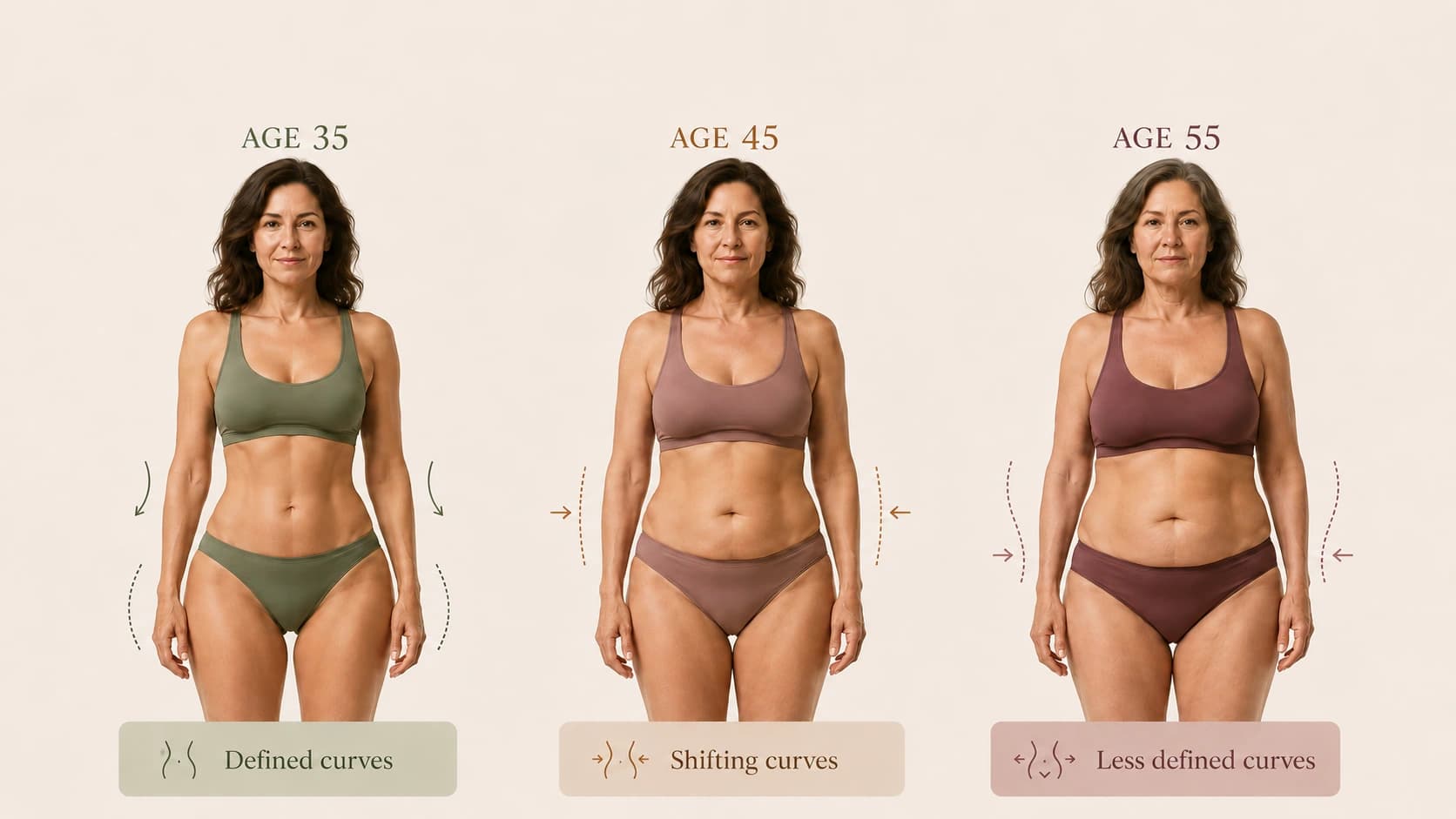
Have you ever wondered why your body looks different even though the number on the scale hasn't changed?
For many women over 50 entering perimenopause and menopause, the biggest transformation isn't necessarily weight gain, it's a gradual shift in body composition. Research shows that even when body weight remains stable, women can slowly lose lean muscle while gaining fat. This isn't a sudden overnight change. It's a quiet reshaping of your body that often happens beneath the surface.
Many women feel like their curves have simply disappeared.
The truth is, your curves didn't disappear.
They changed.
Understanding what's happening inside your body is the first step toward rebuilding your strength, confidence, and the silhouette you love.
Why Your Body Shape Changes During Menopause
One of the biggest drivers of body shape changes after 50 is declining estrogen.
As estrogen levels fall, your body gradually changes where it prefers to store fat. Instead of depositing more fat around the hips and thighs, it begins storing more around the abdomen and waist.
At the same time, muscle loss accelerates.
Because estrogen helps preserve muscle tissue, losing it means women often lose lean muscle more quickly than men of the same age.
This creates an interesting and often frustrating situation.
You may step on the scale and see exactly the same number you've always seen.
But the mirror tells a different story.
Your hips may look narrower.
Your glutes may appear flatter.
Your waist may feel thicker.
Your overall body may seem softer, even though your weight hasn't changed.
One of the largest women's health studies, the Study of Women's Health Across the Nation (SWAN), found that menopause is accompanied by both fat gain and lean muscle loss. In many women, those changes offset one another, meaning body weight changes very little while body composition changes dramatically.
Some researchers estimate that women may gradually replace up to ten pounds of lean muscle with fat during the menopausal transition if muscle isn't actively maintained.
That's why the scale doesn't always tell the full story.
Your weight can stay exactly the same while your body shape changes significantly.
The Scale Doesn't Measure Shape
Many women assume they're "getting bigger."
In reality, many are simply becoming less muscular.
Muscle takes up less space than fat.
When muscle gradually disappears from the hips, thighs, glutes, shoulders, and back, your body naturally becomes softer and less defined.
This explains why two women can weigh exactly the same while looking completely different.
Imagine weighing 140 pounds today and 140 pounds next year.
The number hasn't changed.
But your hips may be smaller.
Your butt may appear flatter.
Your waist may be wider.
Your clothes may fit differently.
The scale isn't lying.
It's simply measuring total body weight not what that weight is made of.
Body composition matters far more than most women realize, especially during menopause.
Your Glutes Are the Foundation of Your Shape
When women say,
"I don't recognize my body anymore,"
they're often talking about their glutes.
The glute muscles are the largest muscles in the human body.
They help you walk, climb stairs, squat, lift, and maintain balance.
They also create much of the shape people associate with feminine curves.
As glute muscles become weaker or smaller, many women notice:
- Flatter hips
- Less projection through the glutes
- Softer lower-body definition
- Clothes fitting differently around the hips
Many people assume fat simply "moved."
That's only part of the story.
In many cases, what's missing isn't fat.
It's muscle.
Your glutes form the foundation of your posterior chain, helping stabilize your pelvis, support your spine, and maintain efficient movement.
When they weaken, posture changes begin to follow, making the body appear even flatter and less defined.
The encouraging news is that muscle can respond remarkably well to resistance training—even later in life.
Exercises such as squats, lunges, hip thrusts, deadlifts, and glute bridges can help rebuild strength, improve posture, and gradually restore muscle that has been lost over time.
Rebuilding your glutes isn't only about appearance.
It's about creating a stronger, healthier body that supports mobility, balance, bone health, and everyday movement.
Posture and Core: The Hidden Shape-Changers
When most women think about changing their body shape, they immediately think about fat.
Very few think about posture.
Yet posture may be one of the biggest reasons your body looks different after menopause.
Over time, many women gradually develop rounded shoulders, a forward head position, and a slight curve through the upper back.
These changes often happen so slowly that they're almost impossible to notice until they become part of your normal posture.
Why does it happen?
Like every other muscle in the body, the muscles that support your spine become weaker if they aren't challenged regularly.
Long hours spent sitting, working at a computer, driving, or looking down at a phone can make chest muscles tighter while the muscles of the upper back and core become weaker.
Gravity slowly takes over.
Even a small increase in the natural curve of the upper spine can make you appear shorter, softer, and less defined without gaining a single pound.
Poor posture also changes the way clothes fit.
Rounded shoulders flatten the chest, weaken the appearance of your waist, and make the midsection look wider than it really is.
The good news?
Posture can improve.
Strengthening your upper back, shoulders, and core helps you stand taller, creating the appearance of a longer torso, a more defined waist, and stronger overall body shape.
Exercises like rows, planks, scapular squeezes, bird dogs, and other posture-focused movements don't just improve how your body functions—they also change how your body looks.
Sometimes the biggest visual transformation isn't losing weight.
It's simply standing taller.
Why Belly Fat Increases During Menopause
One of the most frustrating changes women notice during menopause is that fat seems to settle around the waist.
This isn't simply the result of eating more.
It's largely influenced by hormones.
Before menopause, estrogen encourages the body to store more fat around the hips and thighs, creating the classic pear-shaped body.
As estrogen declines, those storage patterns begin to shift.
The body gradually favors storing more fat around the abdomen instead.
At the same time, muscle around the hips and glutes often decreases.
The result is exactly what many women describe:
- "My waist disappeared."
- "My hips don't look the same."
- "My body doesn't feel like mine anymore."
Understanding these changes can be incredibly empowering.
Because the issue isn't simply weight gain.
It's body composition.
Fat is being stored differently while muscle is gradually disappearing.
That means rebuilding muscle especially through the hips, glutes, and core—can help restore balance to your overall shape.
The goal isn't chasing a smaller number on the scale.
It's creating a stronger body underneath it.
Rebuilding Your Curves Starts With Strength
Here's the encouraging part.
The changes you see during menopause are not permanent.
Muscle is one of the few tissues in the body that continues to respond to training throughout life.
Research from the Mayo Clinic shows that resistance training can slow—and in many cases reverse age-related muscle loss, even in adults who begin strength training later in life.
Other research has found that middle-aged and older women who perform resistance training several times per week significantly improve both strength and physical function.
That means your curves aren't simply something you lose with age.
They're something you can actively rebuild.
Your shape isn't determined only by genetics.
It's influenced every day by the muscle you maintain, the posture you develop, and the habits you repeat consistently.
Simple habits make a remarkable difference over time:
- Strength train consistently, focusing on glutes, legs, core, and upper back.
- Gradually challenge your muscles by increasing resistance or repetitions over time.
- If longer workouts feel overwhelming, break movement into shorter sessions throughout the day.
- Prioritize exercises that strengthen the hips, glutes, and core to rebuild muscle where women commonly lose it during menopause.
- Eat a balanced diet with enough protein and nutrient-rich foods to support muscle recovery and healthy aging.
- Stay active outside the gym by walking regularly and paying attention to posture throughout the day.
None of these habits need to be extreme.
They simply need to be consistent.
Small actions repeated week after week create meaningful changes in both strength and body composition.
The Bottom Line
If your body doesn't feel familiar anymore, you're not imagining it. Menopause changes muscle, fat distribution, and posture in ways that can completely reshape your silhouette even without significant weight gain. But this isn't the end of your strongest body.
Muscle is remarkably responsive to training, and every strength workout is an investment in the way you'll look, move, and feel in the years ahead. Rather than chasing a smaller number on the scale, focus on building a stronger body. Because healthy aging isn't about looking younger,it's about becoming stronger, more capable, and more confident with every passing decade. Your curves didn't disappear.
They changed and with the right habits, they can be rebuilt.
References
- The Menopause Society. Resources on menopause, body composition, and healthy aging.
- Mayo Clinic. Resistance training and healthy aging.
- World Health Organization. WHO Guidelines on Physical Activity and Sedentary Behaviour. 2020.
- American College of Sports Medicine. ACSM's Guidelines for Exercise Testing and Prescription.
- U.S. Department of Health and Human Services. Physical Activity Guidelines for Americans. 2nd Edition.
- Study of Women's Health Across the Nation. Research on menopause-related body composition changes.
- Peterson MD, Sen A, Gordon PM. Influence of Resistance Exercise on Lean Body Mass in Aging Adults: A Meta-analysis. Medicine & Science in Sports & Exercise.
- Fragala MS, et al. Resistance Training for Older Adults: Position Statement From the National Strength and Conditioning Association. Journal of Strength and Conditioning Research.
- University of California, Los Angeles. Research on strength training benefits for middle-aged and older women.
- Sherrington C, et al. Exercise for Preventing Falls in Older People Living in the Community. Cochrane Database of Systematic Reviews.