July 8, 2026
There is a particular kind of frustration that many women encounter somewhere in their late 40s, 50s, and beyond, and it often arrives despite doing everything they have been told should work. They show up for their workouts several times a week, they lift weights, attend classes, follow programs online, and remain far more consistent than they were in their younger years, yet when they look for evidence that their efforts are translating into meaningful changes in strength, muscle tone, energy levels, or body composition, they find themselves asking the same question over and over again: Why does it feel like nothing is happening anymore?
The assumption is usually that menopause has changed everything, that hormones have somehow made progress impossible, or that age itself has become an insurmountable obstacle. While there is no question that the hormonal changes associated with perimenopause and postmenopause influence how the body responds to exercise, particularly when it comes to recovery, muscle protein synthesis, and body composition**, the explanation is often far less dramatic** than most women imagine. In many cases, strength training has not stopped working at all. The body has simply stopped receiving a reason to continue adapting.
When Your Body Becomes Too Good at Your Workout
One of the most remarkable qualities of the human body is its ability to become efficient. Every time we perform a movement, whether it is a squat, a row, a push-up, or a resistance-band exercise, the body learns how to perform that movement with slightly less effort than before. At first, this process feels rewarding because strength increases rapidly. Exercises that once felt challenging suddenly become manageable, everyday tasks feel easier, and there is a noticeable sense that the body is becoming more capable.
Eventually, however, something changes. The workout that once demanded adaptation becomes familiar, and when familiarity replaces challenge, progress naturally begins to slow.
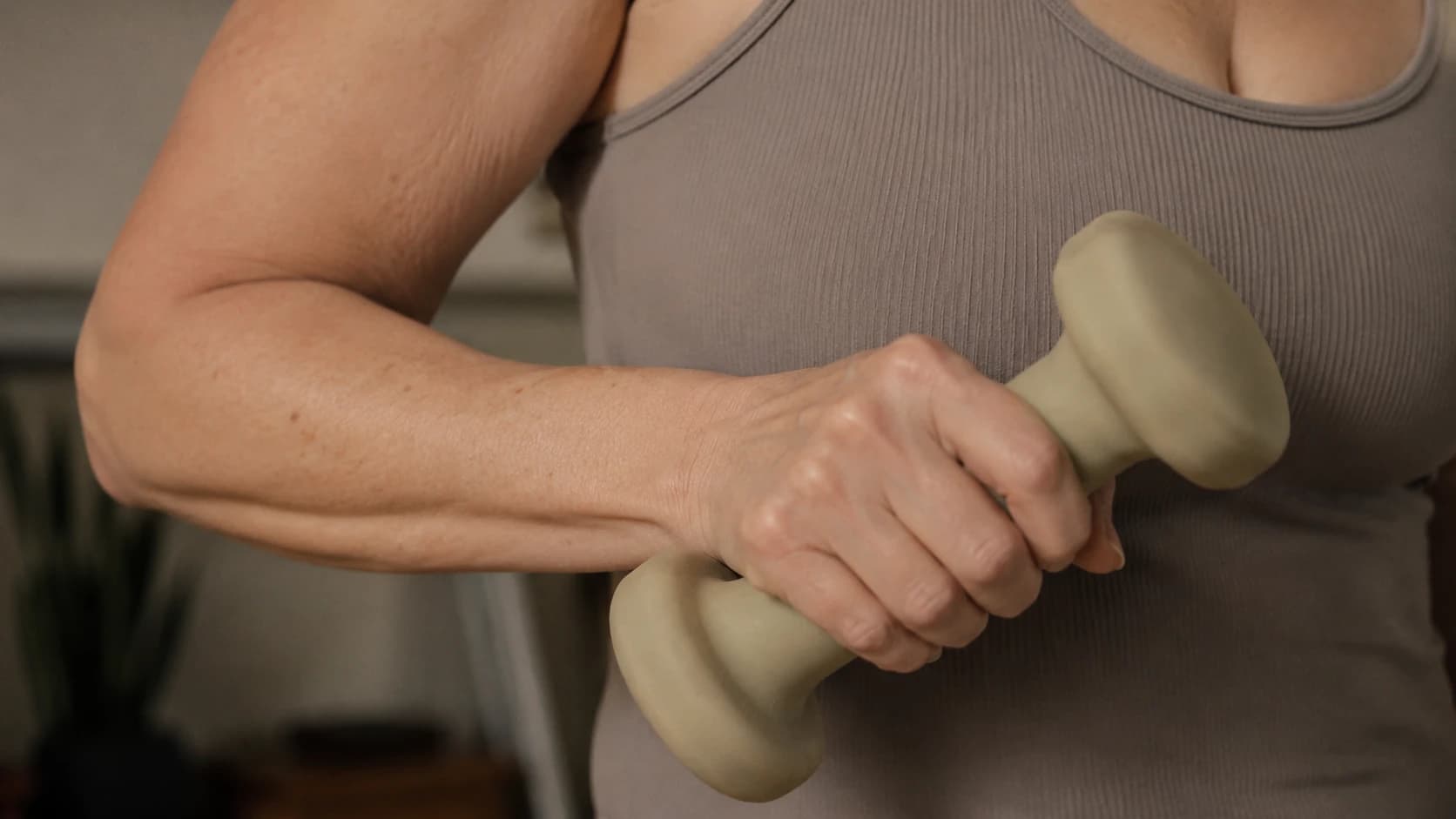
A woman may continue using the same pair of dumbbells she bought two years ago, complete the same number of repetitions she has always completed, and follow the same workout schedule every week, all while expecting her body to continue changing. Yet from the body's perspective, there is no new problem to solve. The muscles have already adapted to those demands. The nervous system has already become efficient at those movement patterns. The connective tissues have already adjusted. What remains is maintenance rather than development.
Why Menopause Raises the Stakes
That distinction becomes increasingly important after the age of 45 because the biological environment is changing at the same time. As estrogen levels begin to decline, women experience changes that affect far more than reproductive health. Estrogen plays a role in muscle maintenance, recovery, connective tissue health, and bone metabolism. As those hormonal shifts occur, preserving muscle becomes less automatic than it once was. The body requires a stronger signal to maintain lean tissue, and without that signal, age-related muscle loss, known as sarcopenia, can gradually begin to accelerate.
This is one reason why women often describe feeling softer despite exercising regularly. It is not necessarily that they have stopped being active. Rather, the activities they are performing may no longer provide enough resistance to offset the physiological changes occurring beneath the surface. What worked at thirty-five may maintain function at fifty-five, but maintenance and improvement are not the same thing.
Progressive Resistance: The Missing Link
The solution lies in a principle that has been recognized in exercise science for decades but is still surprisingly misunderstood by the general public: progressive resistance.
Despite the intimidating name, progressive resistance is not about turning every workout into a grueling test of willpower. It is not about chasing exhaustion, training to failure, or attempting dramatic increases in weight from one week to the next. Instead, it is about gradually increasing the demands placed upon the body so that adaptation continues. The keyword is gradual. Progression should feel intentional rather than aggressive, creating a challenge that is meaningful enough to stimulate change without being so large that recovery becomes compromised.
For some women, progression may come from increasing the amount of weight they lift. A dumbbell that once felt challenging for ten repetitions may eventually become manageable for twelve or fifteen, at which point a slightly heavier load provides a fresh stimulus. The increase does not need to be dramatic. In fact, some of the most successful long-term strength programs are built upon surprisingly small increases repeated consistently over months and years.
More Weight Isn't the Only Way to Progress
For others, progression may have nothing to do with heavier weights at all. A woman training at home with limited equipment can continue making progress simply by increasing repetitions, adding another set, improving range of motion, or reducing the amount of assistance she uses during a movement.
A squat performed to a chair can become a free squat. An incline push-up can gradually evolve into a lower incline. What matters is not the specific method but the fact that the body is being asked to do slightly more than it has already mastered.
Resistance bands offer another overlooked opportunity for progression, particularly among women who prefer home workouts or who experience occasional joint discomfort. Because band tension can be adjusted easily, they provide a practical way to increase resistance without the need for a large collection of weights. A stronger band, a shorter band position, or simply controlling the movement more deliberately can transform an exercise that has become easy into one that once again challenges the muscles.
Perhaps the most underrated progression strategy of all is tempo. Most exercisers focus exclusively on how much weight they are lifting while paying very little attention to how they are lifting it. Yet slowing the lowering phase of an exercise from one second to three or four seconds dramatically increases muscular demand without changing the load at all. Suddenly, a weight that felt ordinary becomes significantly more challenging because the muscles are required to remain under tension for longer periods.
Why Small Changes Create Big Results
What often surprises women is how little progression is actually required to reignite adaptation. The body does not demand massive changes. It simply requires a reason to continue improving. A few additional pounds, a few extra repetitions, a slightly slower tempo, or an additional set may be enough to create the stimulus that has been missing for months.
At the same time, progression should never be confused with constant escalation. More is not always better, especially during and after menopause when recovery becomes increasingly important. The goal is not to make every workout harder than the last. The goal is to create periods of challenge followed by sufficient recovery, allowing the body to respond positively to the stress being applied. Strength is built not only through training but through the body's ability to recover from training.
Strength After 45 Is About More Than Appearance
This perspective can be incredibly liberating for women who have spent years believing that stalled progress is evidence of personal failure or unavoidable aging. In reality, the plateau often reflects nothing more than successful adaptation. The body has become efficient, and efficiency is not a problem to solve but a signal that it may be time for a new challenge.
Viewed through that lens, the conversation changes entirely. Instead of asking why strength training no longer works, the better question becomes whether the training is still asking the body to change. Because muscles do not respond to effort alone. They respond to demand. And after 45 when maintaining muscle mass, preserving bone density, supporting metabolism, and protecting long-term independence become increasingly important, progressive resistance remains one of the most powerful tools available for ensuring that strength training continues delivering results long after the beginner phase has passed.
Key Takeaway
If you've been saying, "I've been training for a year and nothing is changing," the answer may not be to work harder. It may be to work progressively. Whether through heavier weights, stronger resistance bands, additional repetitions, slower tempo, or more challenging exercise variations, the body needs a reason to keep adapting. For women over 45, progressive resistance is often the difference between simply exercising and continuing to get stronger year after year.
Evidence-Based Citations
- American College of Sports Medicine (ACSM). Progression Models in Resistance Training for Healthy Adults.
- U.S. Department of Health and Human Services. Physical Activity Guidelines for Americans, 2nd Edition.
- Centers for Disease Control and Prevention. Growing Stronger: Strength Training for Older Adults.
- Cho J. et al. Role of Exercise in Estrogen Deficiency-Induced Sarcopenia.
- Wright N.C. et al. The Musculoskeletal Syndrome of Menopause.
- Isenmann E. et al. Resistance Training Alters Body Composition in Middle-Aged Women Depending on Menopause Status.
- Tan S.Y. et al. Effect of Non-Pharmacological Interventions on the Prevention of Sarcopenia in Menopausal Women.
- National Institute on Aging (NIA). Exercise and Physical Activity for Older Adults.
- National Institute of Arthritis and Musculoskeletal and Skin Diseases (NIAMS). Exercise for Your Bone Health.