May 21, 2026
There's a story a lot of women carry around for decades without ever really questioning it, and it goes something like this: if you want to feel better, look better, and be healthier, the answer is always to eat a little less, try a little harder, and tolerate a little more discomfort and for a long time, that story worked well enough that it felt like truth.
But somewhere in your mid-40s, the story starts to fall apart, and the frustrating part is that most women don't blame the story, they blame themselves.
The Habit Nobody Talks About But Almost Every Woman Over 45 Has
It didn't happen on purpose, and it probably didn't happen all at once.
Maybe it started with years of on-and-off dieting, where eating less became the automatic response to any feeling of discomfort in your body. Maybe it was the relentless busyness of your 30s and 40s kids, career, caregiving, the endless mental load of holding everything together where skipping lunch just became the path of least resistance and breakfast became a coffee you drank standing over the sink. Maybe it was the deeply ingrained cultural message, aimed specifically at women, that taking up less space and needing less food is somehow a virtue rather than a warning sign.
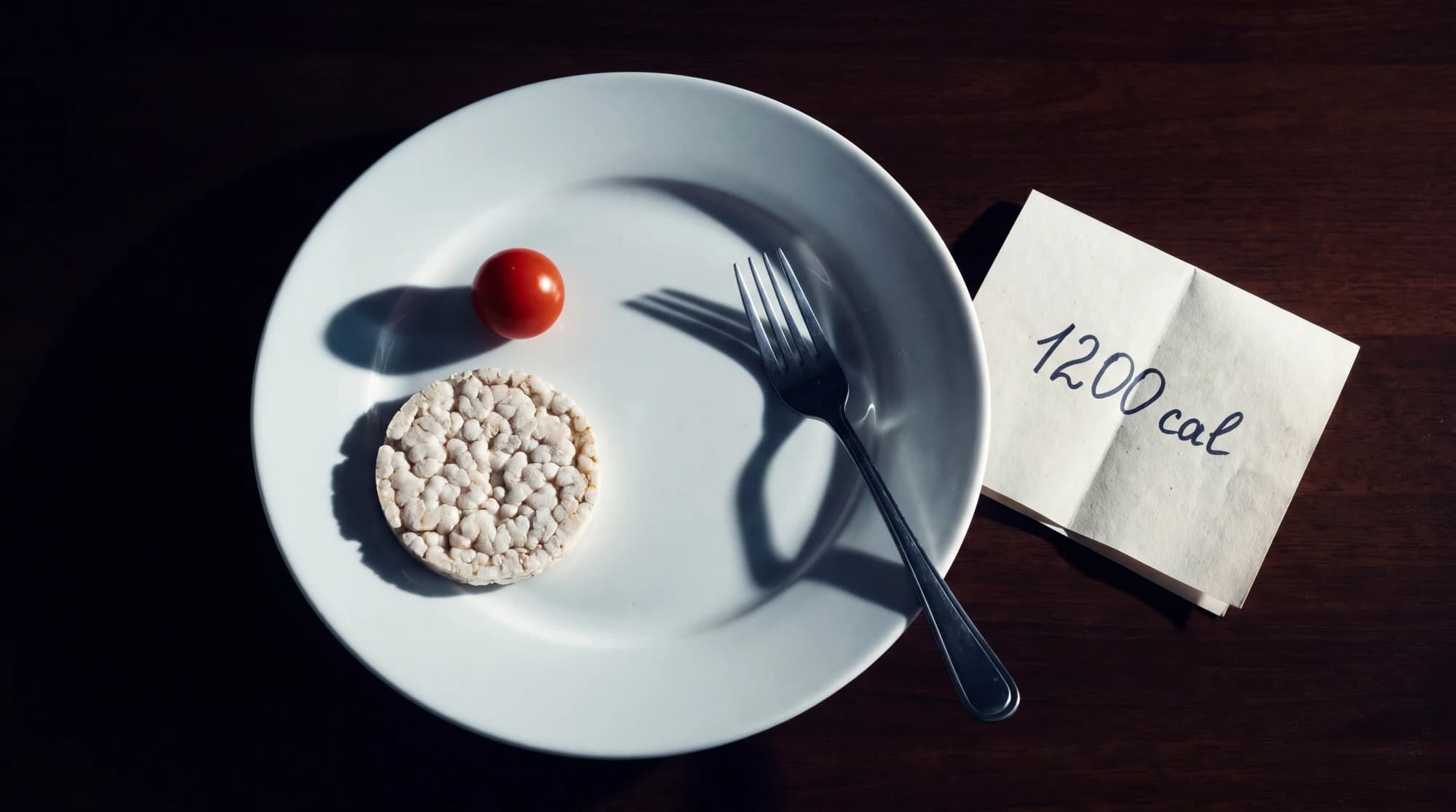
Whatever the origin, the result is the same: a lot of women in midlife are chronically under-eating, and they don't even know it, because it has become so normalised over the years that it simply feels like life.
The coffee-only morning. The handful of crackers at noon. The sensible dinner. And then, somewhere around 9pm, the cravings arrive like a freight train, and instead of understanding that as the body's entirely reasonable response to a day of inadequate fuel, the internal narrative becomes "I have no willpower" which adds a layer of guilt on top of an already depleted system, and makes everything harder.
What Happens When a Body Running on Empty Meets Perimenopause
This is where the biology really matters.
Because during perimenopause, the body is already going through major hormonal changes. And when chronic under-eating gets added on top of that, the body often responds by slowing down, conserving energy, and increasing stress signals.
During this phase, estrogen levels begin to decline and fluctuate. That affects almost every system in the body, including:
-
Metabolism, which becomes less efficient
-
Muscle tissue, which becomes harder to maintain
-
Cortisol regulation, making the body more stress-sensitive
-
Sleep quality and recovery
-
Energy production throughout the day
-
Blood sugar balance and cravings
When the body is not getting enough nourishment during this transition, cortisol levels often stay elevated for longer periods.
And higher cortisol is linked to:
-
Increased belly fat storage
-
Stronger sugar cravings
-
Persistent fatigue
-
Mood swings and irritability
-
Poor sleep quality
-
Feeling emotionally overwhelmed
-
Slower workout recovery
This is why many women in midlife feel like their body has suddenly “turned against them.”
They may notice:
-
Constant tiredness
-
Brain fog
-
Feeling hungrier at night
-
Working out harder with fewer results
-
Feeling emotionally reactive
-
Low motivation and energy
And while many of these symptoms are blamed entirely on menopause, sometimes the body is also responding to something much simpler: not getting enough fuel to support everything it’s trying to manage.
What Supporting Your Body Actually Looks Like And Why It Feels Counterintuitive
The shift that changes everything for a lot of women in midlife is the moment they stop asking "how little can I eat to get the result I want?" and start asking "what does my body actually need to function well right now, in this phase of life?"
And the honest answer to that second question is probably more than - you're giving it more protein, more consistent meal timing, more intentional nourishment before and after exercise, and more permission to eat a real breakfast rather than treating the morning as a fast you're extending for as long as willpower will allow.
-
Protein matters more in midlife than at any previous point in your adult life, not because someone told you muscles are important, but because as estrogen declines, the rate at which your body breaks down muscle tissue accelerates, and dietary protein is the most direct tool you have for slowing that breakdown and supporting the muscle mass that underpins your metabolism, your bone density, your balance, your energy, and your long-term physical independence and the research consistently suggests that women over 45 need more protein than they did in earlier decades, not less.
-
Eating consistently throughout the day actual meals, not the snack-and-survive approach stabilises blood sugar, which stabilises cortisol, which stabilises mood, sleep, energy, and cravings in a way that no amount of evening restriction ever will, and women who make this shift often describe it as the first time in years that they feel genuinely in control around food, not because they're being more disciplined but because they're no longer physiologically desperate by 4pm.
-
And perhaps most importantly: recovery from exercise which matters enormously in midlife, when the hormonal environment means your body takes longer to repair from training stress depends directly on having enough fuel in the system to do the repair work, which means that the combination of intense exercise and inadequate eating that many women are quietly doing is one of the most efficient ways to feel permanently exhausted and to wonder why the gym isn't delivering the results it used to.
The mindset shift underneath all of this is genuinely radical for a lot of women, because it asks you to reframe nourishment as something you do for your strength rather than something you do for your appearance.
To understand that a body in midlife that is well-fed, well-rested, well-moved, and well-supported is going to serve you infinitely better than a body that has been disciplined into submission and then blamed for its exhaustion.
Citations
-
North American Menopause Society (NAMS)
-
National Institute on Aging – Healthy Eating and Aging
-
Harvard Health Publishing – Menopause, Nutrition, and Metabolism
-
Mayo Clinic – Menopause and Weight Changes
-
Academy of Nutrition and Dietetics
-
Journal of Midlife Health – Nutrition and Menopause Research
-
Cleveland Clinic – Menopause and Hormonal Health
-
American College of Sports Medicine (ACSM) – Nutrition and Exercise Recovery